


Are software engineers more like farmers or radiologists?
In 1900, 40% of Americans worked in agriculture. By 2022, it was 1.2%. Tractors, combines, and technology made farming massively more efficient. Food production exploded. We just needed far fewer people to do it.
In 2016, Geoffrey Hinton, the godfather of AI, declared that people should stop training radiologists. AI could already detect pneumonia better than board-certified doctors. The job was just pattern-matching. The conclusion seemed obvious.
Except it didn't happen.
By 2025, radiology residency positions hit a record high. Salaries jumped to $571,749, up 7.5% in a single year, making it the 3rd highest-paid medical specialty in the country, surpassing cardiology.
AI didn't replace radiologists. It made them busier and more expensive.
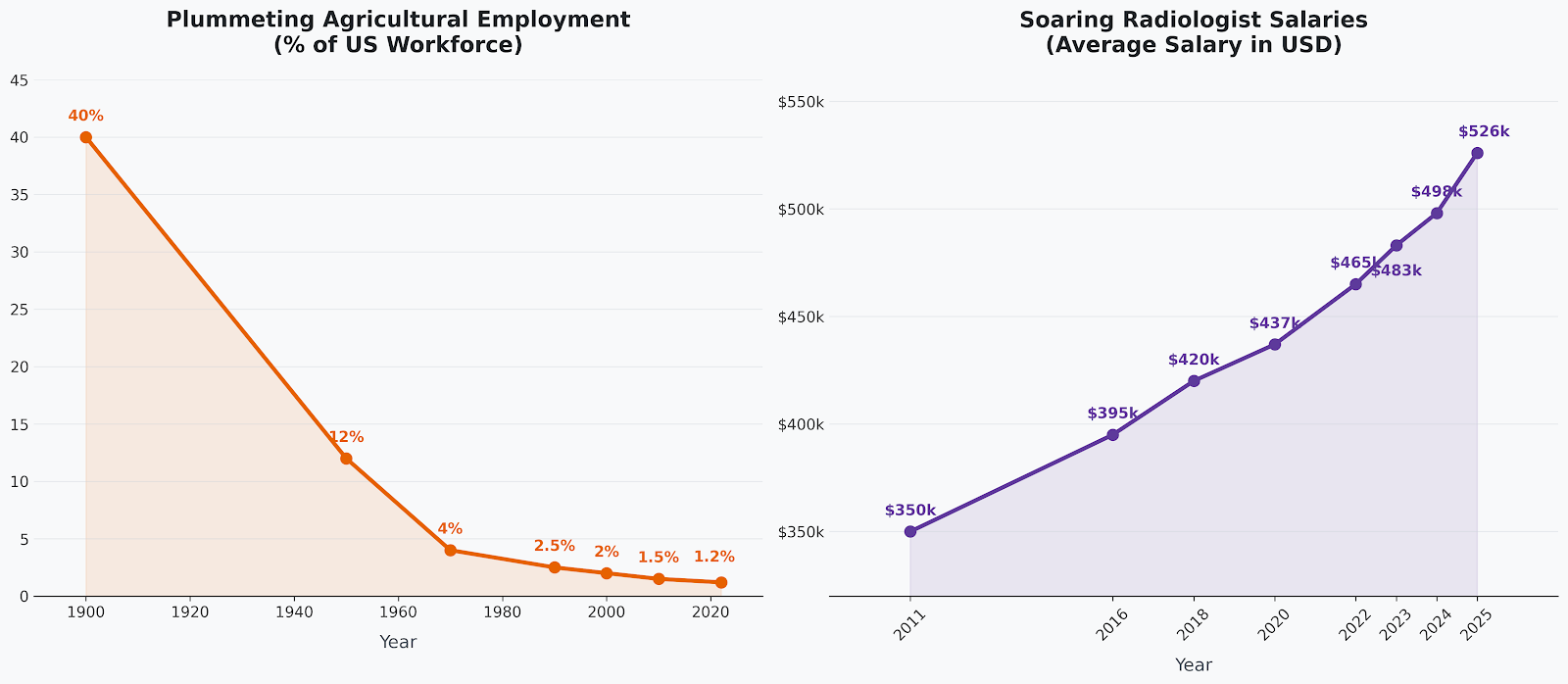
The same economic force was at work in both cases. When tasks get faster or cheaper, we do more of them. Economists call this the Jevons paradox. But one profession thrived and the other consolidated.
Why?
The Commodity Trap
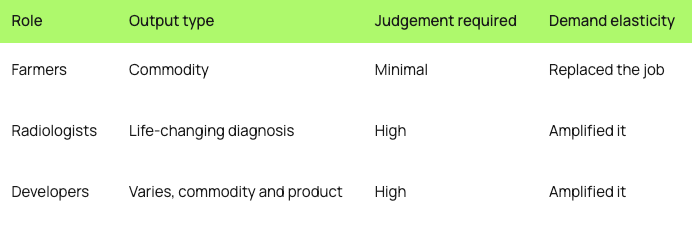
A farmer tills the soil, plants seeds, monitors crops, manages irrigation, applies fertilizer, harvests, and stores crops. Each task is defined and repeatable. The output, rice, wheat, and corn, is identical, a commodity regardless of who grew it.
There's an entire industry, literally called commodity trading, built around this.
Defined input to a defined process for a defined output. The only thing worth competing on is volume at the lowest cost. When machinery could do each task faster and cheaper, there was nothing left to protect. The job was the automation target.
Demand for food grew. But productivity gains outpaced it by a massive margin.
What happened in Radiology?
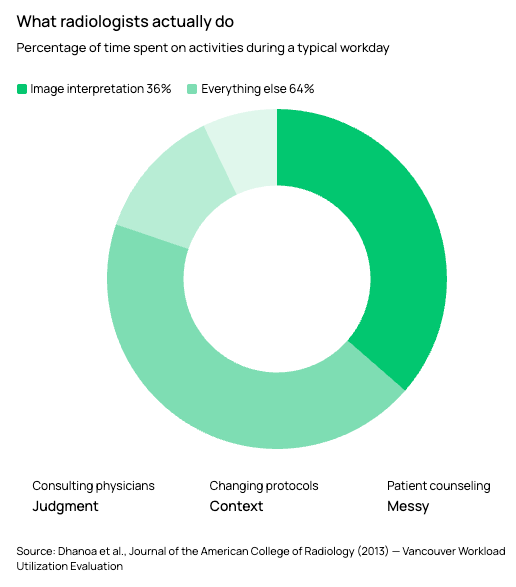
Reading scans is about 36% of a radiologist's job. The other 64% requires judgment.
Radiologists counsel patients about what scans mean for treatment. They consult with surgeons about whether imaging confirms what was suspected or reveals something unexpected. They review orders and change protocols.
The interpretation itself requires context that AI doesn't have. A model flags surgical staples as hemorrhages because of bright streaks in the image. A radiologist knows the patient just had surgery.
AI radiology models are trained on clean, unambiguous cases. Perfect angles, good lighting, confirmed diagnoses reviewed by 2-3 experts. That's not what hospitals see. Real hospitals get blurry images, unusual angles, and patients with multiple overlapping conditions. A pneumonia model trained at one hospital can drop in accuracy by 20% at another.
The judgment, context, and messiness can't be automated. That's developed over years of practice and honing their skills.
The Note-taking app test
So, where do developers fall?
Say you want to build a note-taking app. Before a single line of code gets written, here are just some of the decisions in front of you: Should it be desktop or mobile? If it includes mobile, should it be for iOS, Android, or both? Desktop app or cloud-based? Does it need real-time sync? Should it support markdown, in v1 or later? Who's the core user: a student, a researcher, a professional? Folders, tags, or flat search? Offline mode? Collaboration? Version history?
None of these has a right answer.
They depend on who you're building for, what you're optimizing for, and sometimes what your company believes about how software should work.
That's why there are dozens of note-taking apps, such as Notion, Obsidian, Bear, Roam, and Apple Notes, each with devoted users. The output is not a commodity. Two teams building "a note-taking app" can ship products that barely resemble each other.
Software is different. There's no fixed output. No one thing is the right answer.
Taste, judgment, and systems thinking are critical skills that need to be honed.
The New Job
If you define the developer role as "converting English to a programming language by writing code manually," that job is in serious decline. You've made it prescriptive, like farming.
But if you define it as orchestrating systems, understanding what users need, making architectural tradeoffs, shipping something people actually want, that's radiology.
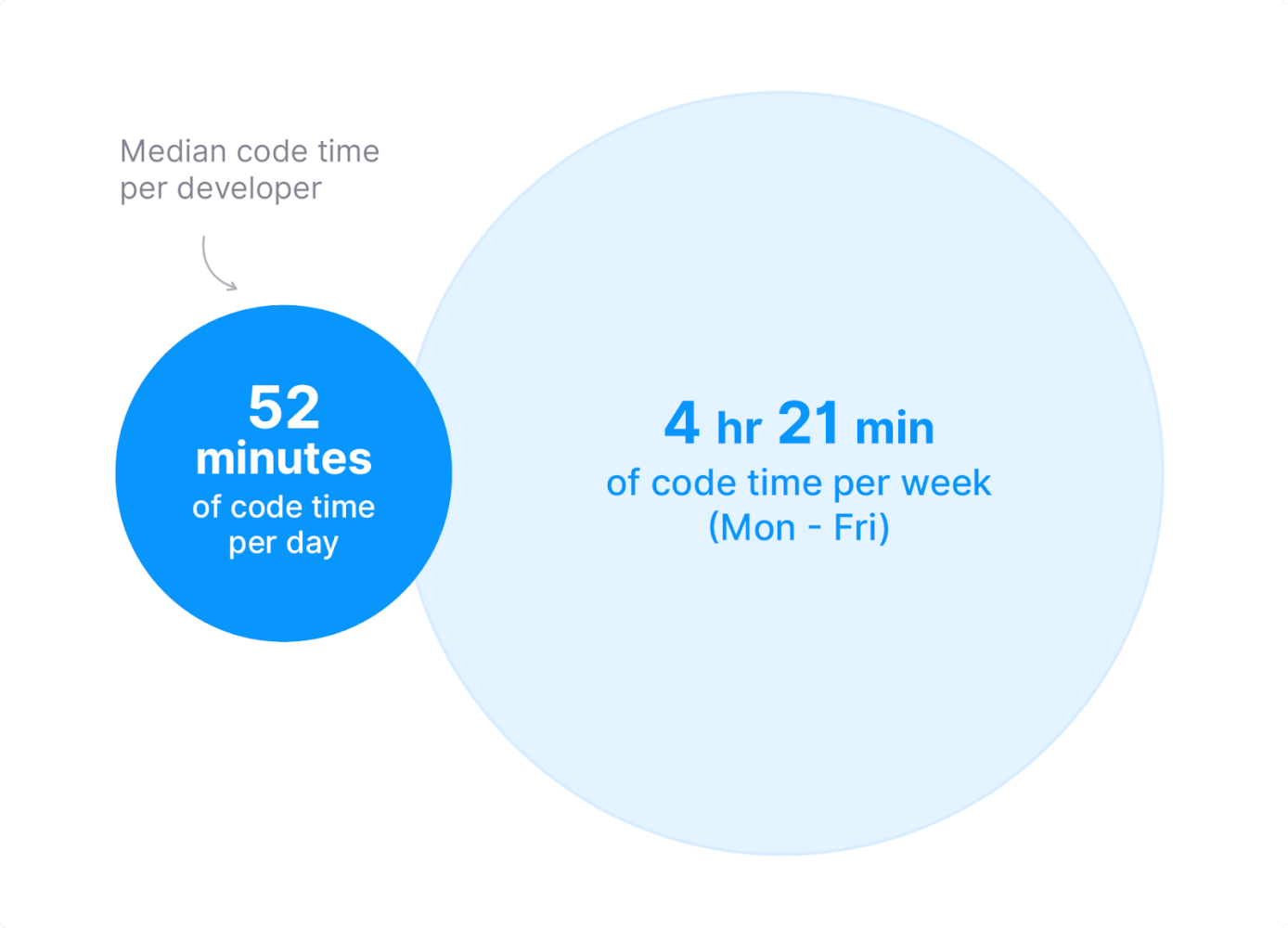
Most developers already spend less than a third of their time writing code.
A survey of 250,000+ developers found the median is 52 minutes of actual coding per day. The rest is architecture, debugging, code review, requirements, operational work, and meetings.
The parts AI can't fully handle, architecture, judgment, and knowing why something shouldn't be built at all, are the parts that define what a developer actually is.
Future
The demand for this kind of developer, an orchestrator of AI agents, is growing.
Our own data shows customers ran 32% more technical interviews last year than the year before, with a significant percentage of them being AI-assisted. Companies aren't hiring fewer engineers. They're hiring differently.
Every abstraction layer in the history of software, from machine code to assembly, from assembly to high-level languages, to frameworks, and to cloud infrastructure, has produced more developers, not fewer. Each time, coding got easier, and the developer population grew.
AI is the next abstraction layer. It will expand the field again.
Can AI build a note-taking app? Of course. But a human with AI will build a far better note-taking app because the hard part was never writing the code. It was knowing which app to build, for whom, and why.
Radiologists figured out what AI couldn't do. Developers will do the same.
The job isn't going away. It's becoming judgment instead of syntax. And a lot more people are about to qualify.
What do you think?
References
- "Why AI Isn't Replacing Radiologists" — Works in Progress
- Physician Compensation Report 2025 — Doximity (survey of 37,000 U.S. physicians)
- Medscape Physician Compensation Report 2025 — radiology ranked 3rd highest-paid specialty
- "Trends in American Farming" — Gilder Lehrman Institute / U.S. Census Data
- "Farm Labor" — USDA Economic Research Service / Bureau of Labor Statistics
- "Global Code Time Report" — Software.com (survey of 250,000+ developers)
- Dhanoa et al., "The Evolving Role of the Radiologist: The Vancouver Workload Utilization Evaluation Study" — Journal of the American College of Radiology (2013)


