


"If candidates can use AI in our assessment, what are we actually testing?"
Historically, developers were evaluated on their ability to write functionally correct code. AI can do that now. The new evaluation focuses on a candidate's judgment and critical thinking when they use AI. We call this AI fluency, and it helps you evaluate when a candidate trusts an AI model's output, when they push back, and whether they can read an AI-generated pull request and find the bug.
A vibe coder does lazy prompting and accepts whatever comes back. An AI-assisted engineer has strong software engineering fundamentals coupled with AI fluency. That is the difference your hiring process needs to surface.
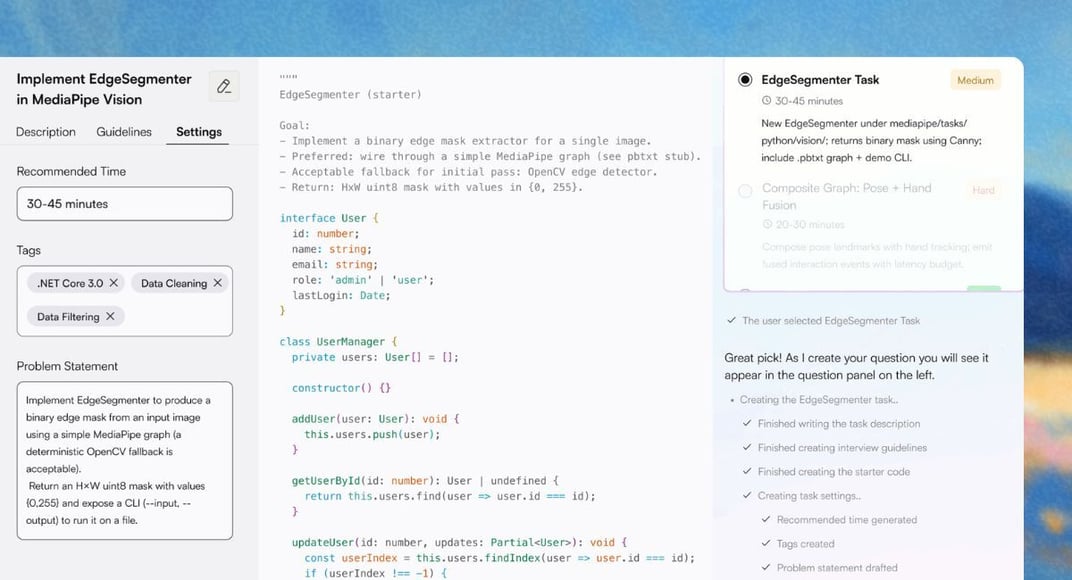
To evaluate this, you need the right questions and the right candidate experience. Our Spring release allows you to import your own code repositories (we already have 26 code repos with 268 tasks ready to use out of the box) and have interview-level AI controls, so you can evaluate fundamentals with the AI assistant off and AI fluency with it on.
Vibe coders and software developers will both exist in your funnel. The question is whether your hiring process can tell them apart.
How To Trust The Result
"If we let candidates use AI, how can we trust the result?"
This is the integrity question, and it is the one I think the industry is getting wrong.
The dominant framing is that AI is a threat. Candidates are using AI, therefore our job is to detect it and stop it. That framing is a dead end. It treats AI as the enemy when AI is the job. It positions the assessment vendor as the police and the candidate as the suspect. And every detection mechanism is in an arms race with the next workaround.
We think about it differently.
Integrity at HackerRank is an ethos, not a feature.
It is not about whether the candidate used AI. It is about whether the candidate followed the rules you set. AI on means AI on. AI off means AI off. A rules violation is a rules violation, same as any era of testing.
Working with customers and looking at platform data, we see three areas that affect the integrity of a hiring process:
1. Questions getting leaked on the web
2. Usage of suspicious tools
3. Impersonation
Our integrity stack addresses all three, and our Spring release makes each layer stronger.
1. Questions getting leaked on the web
We scour the forums and Discord channels where leaked questions show up. When we find one, we flag it in the product, replace it, and send a DMCA notice. Leakage detection for custom questions now runs weekly so you can catch leaks earlier.
2. Usage of suspicious tools
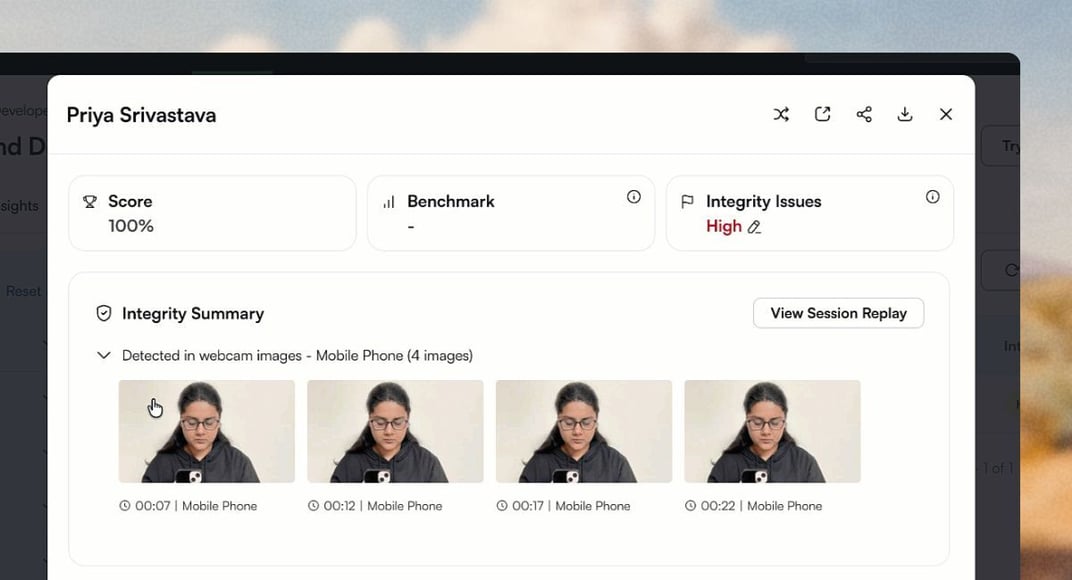
An AI proctor monitors the session and flags suspicious activity. We just added new signals: Object Detection flags mobile phones and tablets in the webcam feed, and Conversation Detection analyzes typed-and-deleted text in the code editor to catch external communication. Both surface in the Integrity Summary and in Session Replay, which now records the full browser screen.
3. Impersonation
We match the candidate's image across every stage of the hiring process to ensure that the person who took the assessment is the person who shows up to the final round interview. Image Analysis improvements in the Spring release make detection more reliable across different testing environments, including campus and lab-based assessments.
Extra Protection with the Desktop App
The integrity layers above all run inside the browser. Our platform data shows elevated suspicious behavior in certain seniorities and geographies, where browser-level monitoring isn't enough. To ensure a fair experience for everyone, we built a Desktop App. Every mode above is available in the Desktop App, and on top of that, it actively shuts down tools like Interviewcoder, Cluely, and Parakeet that candidates use to cheat.
The signals are stronger than they have ever been. The philosophy is the part I want you to take from this.
What To Do Next
If your team is wrestling with either of these questions right now, you are not alone. Your account team can stand up a sandbox pre-configured with your roles. You can experience it as a candidate, as a hiring manager, and as an admin, before you change anything in production. Not a pitch. A working session.
Here's a prototype of what the next-gen hiring process would look like at your organization.
The world has changed. The role has changed. The two questions above are the right ones to be asking. The Spring release is our answer.
Reach out to your account team.


